 ThreatReady
Home / Products / Attack Reasoning Lab
Attack Reasoning Lab · Available
Think like a defender under pressure.
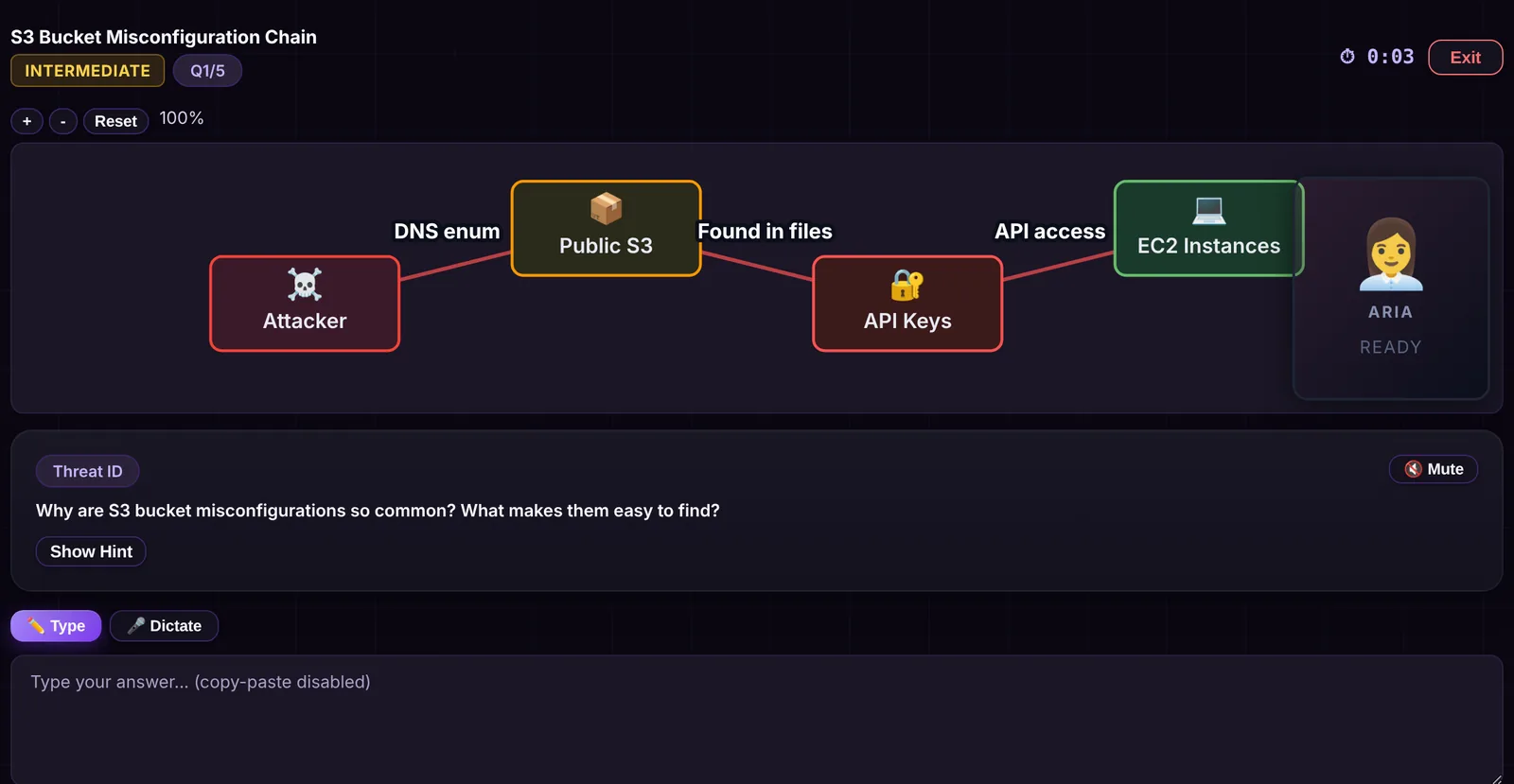
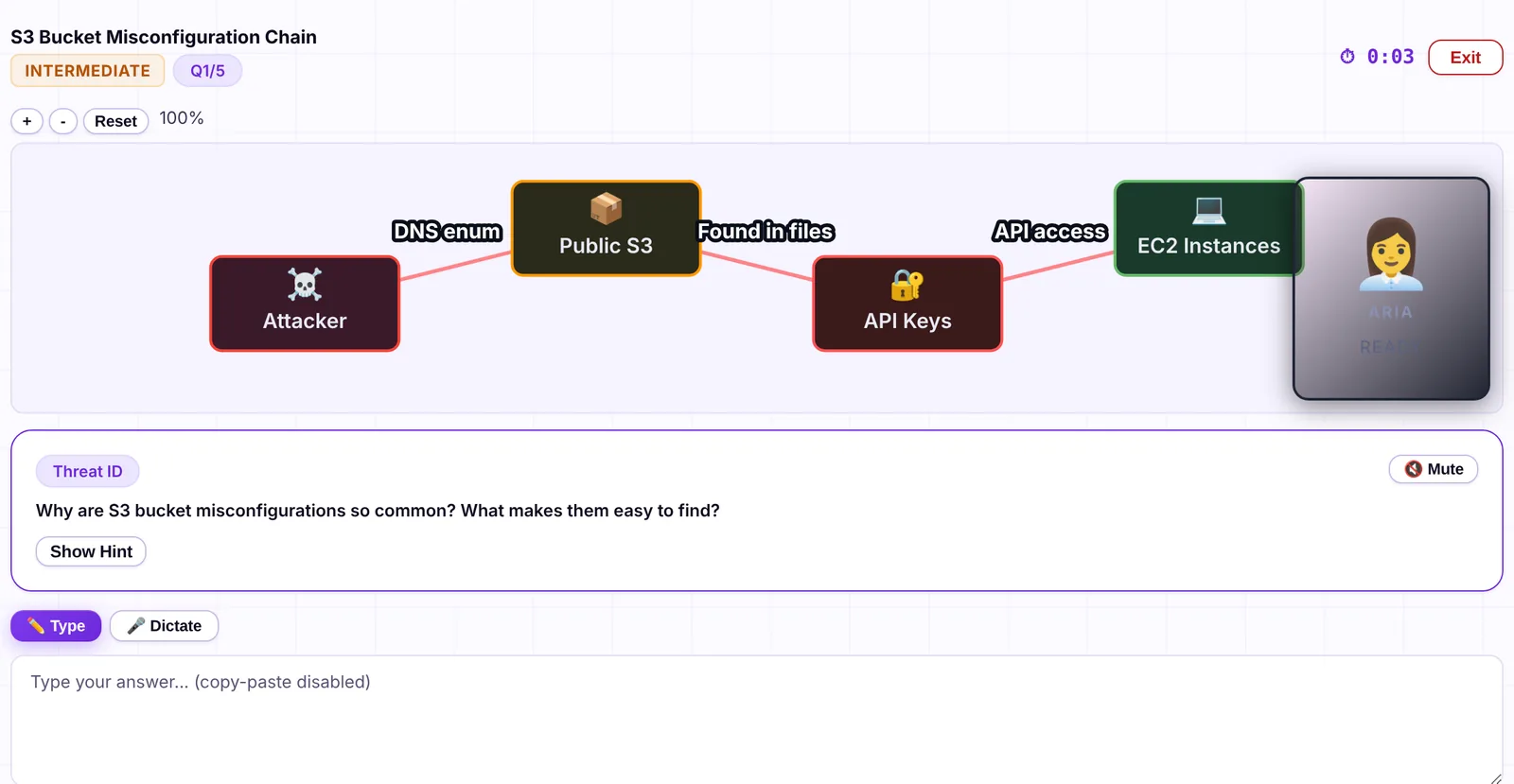
A real architecture with an active attack chain. Five questions, each built from your previous answer. Scored on five published dimensions.
- Format
- 1 architecture scenario · 5 adaptive questions
- Levels
- Beginner, Intermediate, Advanced, Expert
- Answer by
- Typing or voice dictation
- Integrity
- No copy-paste · forward-only · continuous timer
Anatomy of a session
The second question depends on your first answer.
Questions are bounded by the scenario's ATT&CK tactics and the role's competency map. Shallow answers get clarifying follow-ups; strong answers get harder ones.
- Q1Opens on the scenario and its architecture.
- Q2Follow-up generated from your Q1 answer.
- Q3Follow-up generated from your Q2 answer.
- Q4Follow-up generated from your Q3 answer.
- Q5Follow-up generated from your Q4 answer.
Question categories in the scenario pool include Threat ID, Detection, Architecture, Containment, Remediation, Forensics, Triage and Compliance.
Four levels
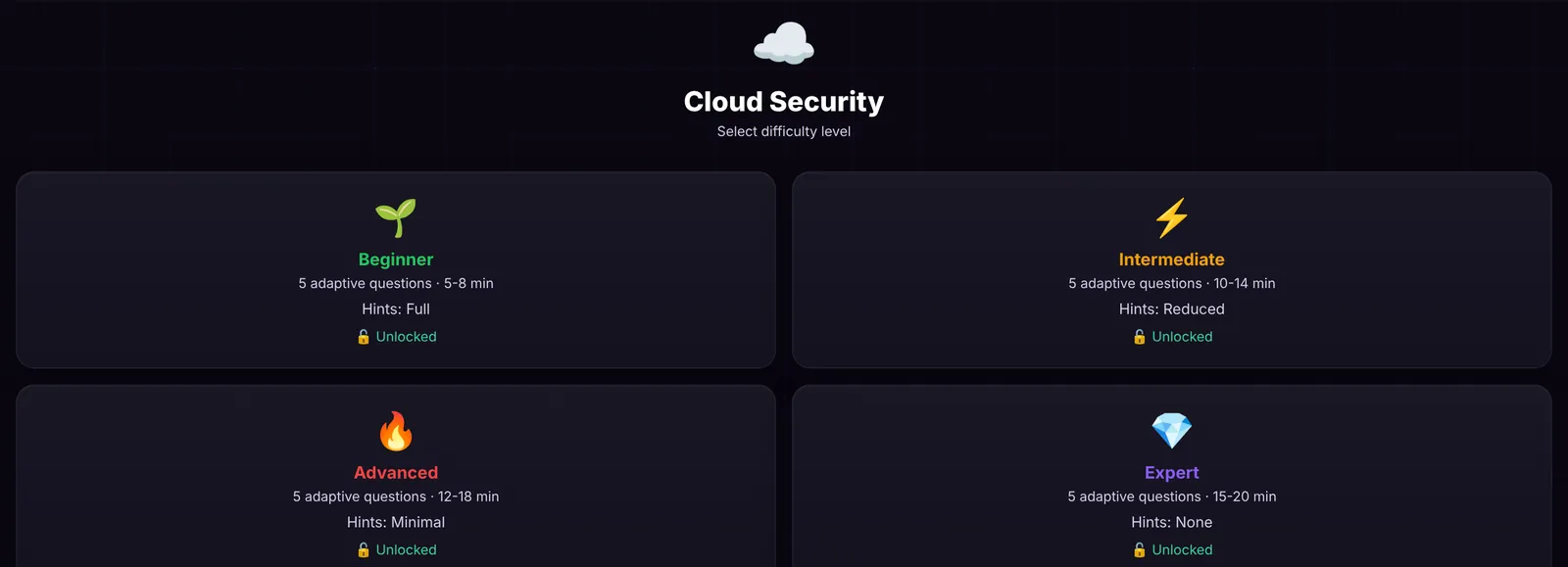
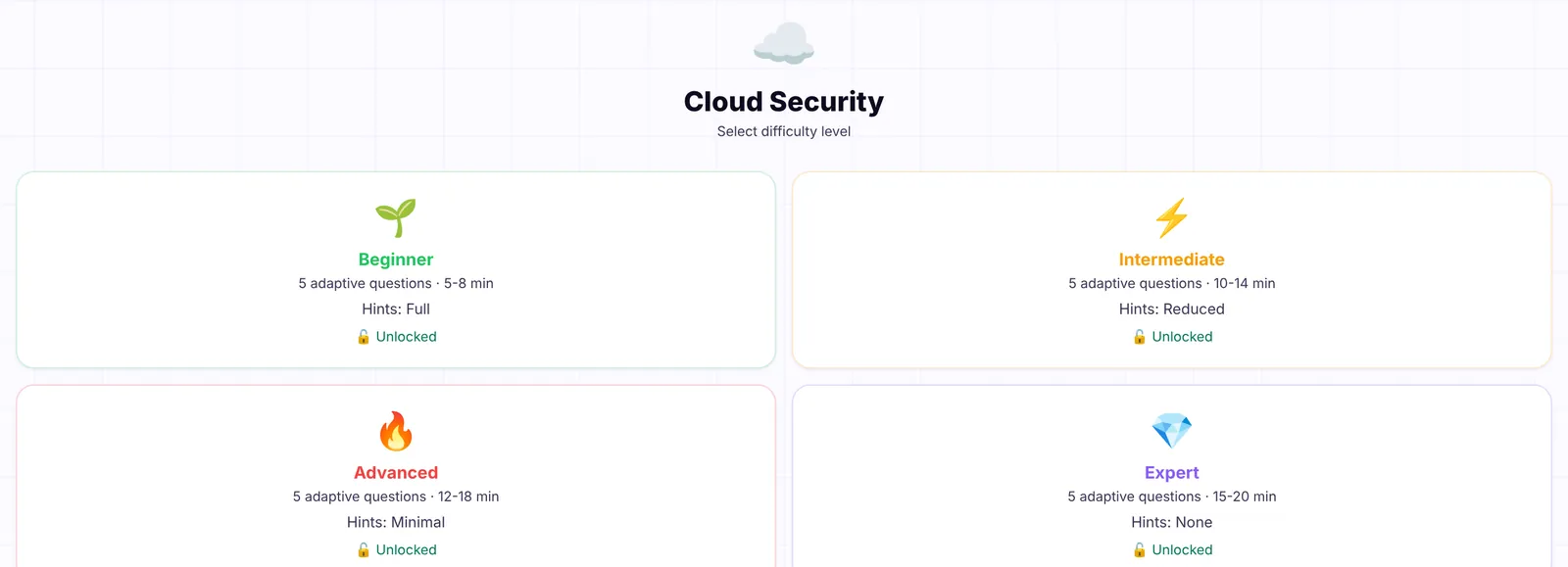
Less help, more depth at each level.
| Level | Time | Hints |
|---|---|---|
| Beginner | 5–8 min | Full |
| Intermediate | 10–14 min | Reduced |
| Advanced | 12–18 min | Minimal |
| Expert | 15–20 min | None |
Every level runs five adaptive questions.
How it's scored
Each question weights the five dimensions differently.
A "map this to ATT&CK" question leans on Threat Identification; an executive briefing leans on Communication. The weights are published in the rubric.
| Question category | TI | CR | AB | CQ | FA |
|---|---|---|---|---|---|
| Threat Identification | 40% | 10% | 15% | 10% | 25% |
| Containment & Response | 10% | 40% | 20% | 15% | 15% |
| Architecture Analysis | 15% | 10% | 40% | 10% | 25% |
| Executive Communication | 10% | 10% | 5% | 50% | 25% |
| Incident Response | 15% | 35% | 15% | 20% | 15% |
| Default (balanced) | 20% | 20% | 20% | 20% | 20% |
0%50%Source: published rubric, §5
Mapped to MITRE ATT&CK
Techniques referenced across the scenarios.
T1078Valid AccountsT1530Data from Cloud StorageT1190Exploit Public-Facing ApplicationT1552.001Credentials in FilesT1562Impair DefensesT1567Exfiltration Over Web ServiceT1566.001Spearphishing AttachmentT1021Remote ServicesT1550.001Application Access TokenT1548Abuse Elevation ControlT1098.001Additional Cloud CredentialsT1195.002Software Supply ChainT1486Data Encrypted for ImpactT1496Resource HijackingTry one question. No sign-up.
Then start free: two Beginner scenarios on any role, no card required.